Oscillation as a constitutive substrate for perception
Is oscillation functional, or decorative? Does a perpetually-circling system of coupled networks — a non-settling “perceiving” system — represent distinctions a saturated, static network of equal capacity cannot?
The minimal substrate is a cyclic triad A→B→C→A whose non-transitive (rock–paper–scissors) coupling forbids a common fixed point and forces a rotating limit cycle — a 120° three-phase splay wave. The program asked, in pre-registered phases, what this collective oscillator does. Each answer forced the next question: from memory, to temporal regulation, to the deepest one — what is the irreducibly-active ingredient of a living oscillation?
1 · The motor exists, and it is trainable
The cyclic Stuart–Landau triad undergoes a clean supercritical Hopf bifurcation: below the coupling threshold it collapses to consensus, above it a stable 120° splay limit cycle is born. The same regime is then shown to be trainable in a real network.
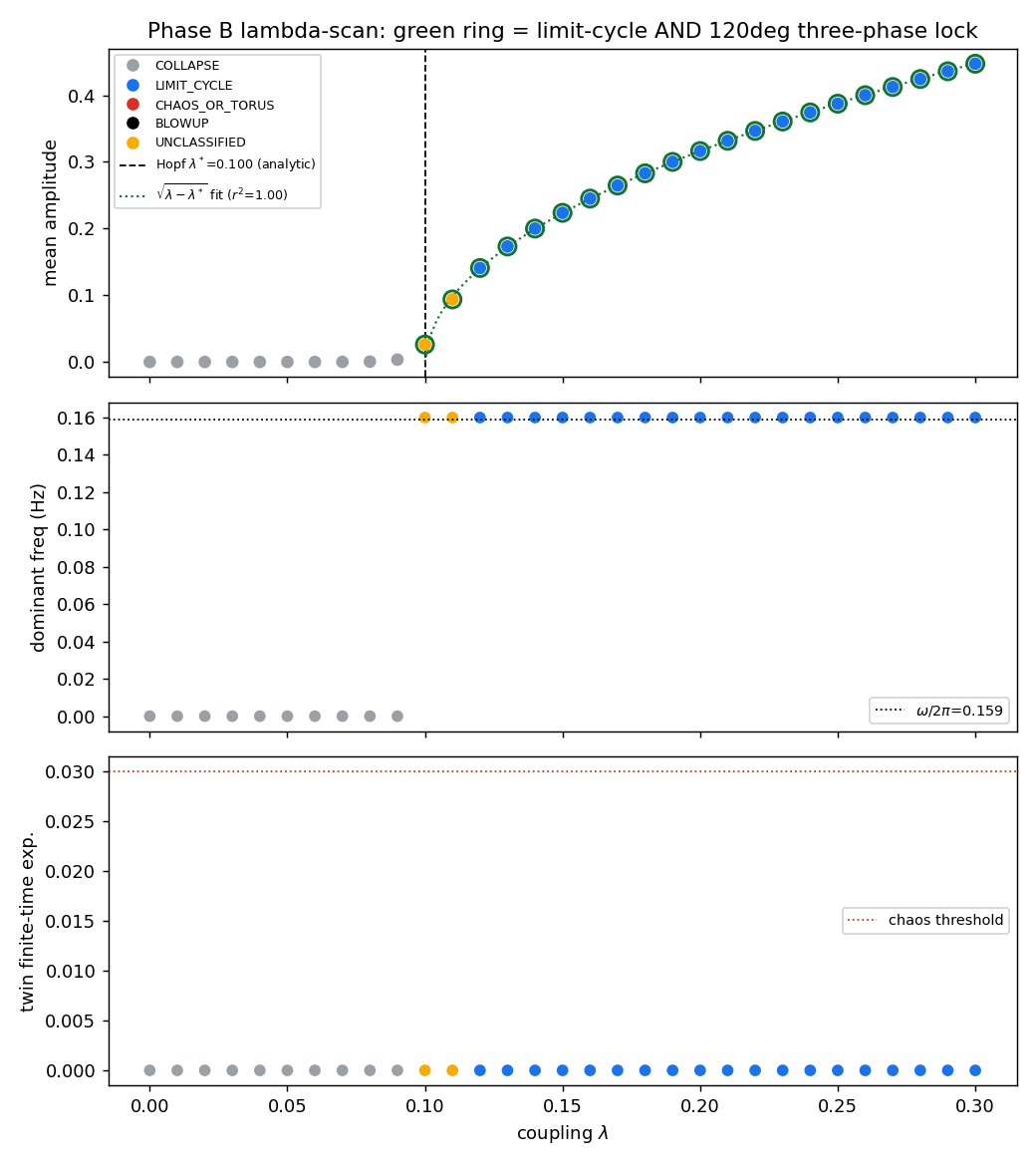
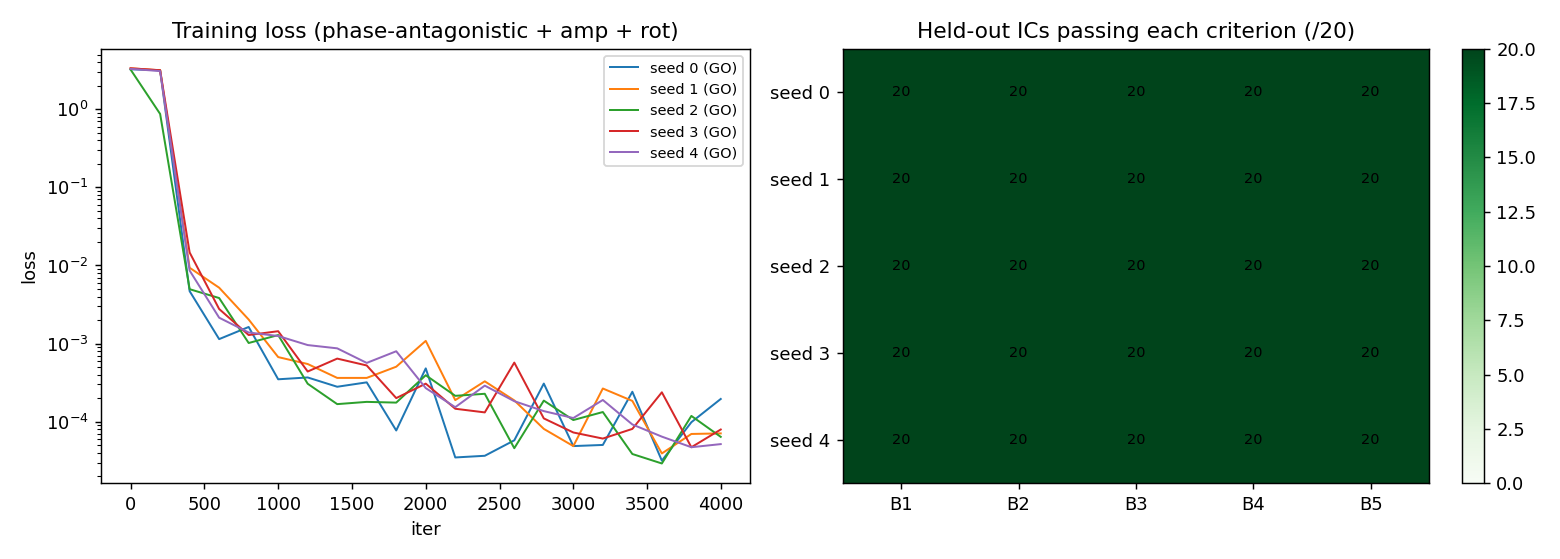
What is earned here is mode-selection, attractor-formation, generalization, and coupling-maintained locking. Boundedness and the supercritical Hopf are partly baked into the normal form, and the loss prescribes the splay's geometry — stated plainly, not papered over.
2 · It is not a memory store — the founding hypothesis, refuted
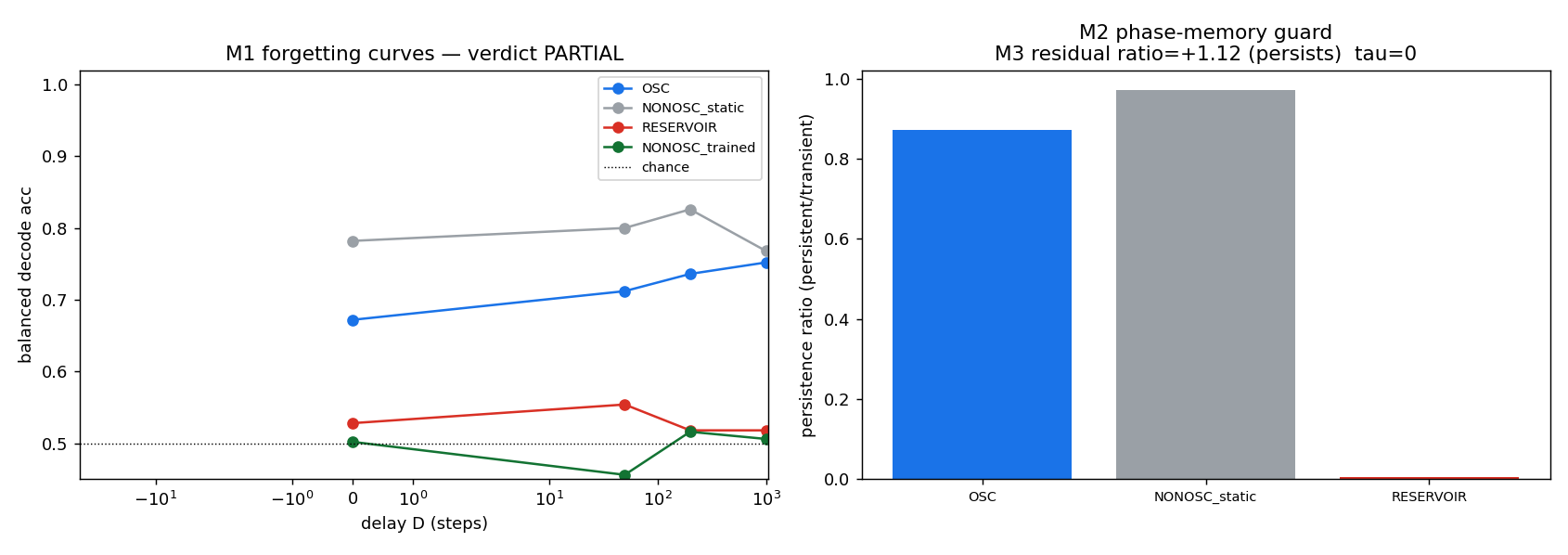
The program began as a memory hypothesis: a non-settling oscillator should hold stimulus structure better than a static net of equal capacity. The data say the opposite.
3 · It is a phase regulator — coupling is a pure robustness knob on a Hopf-universal code
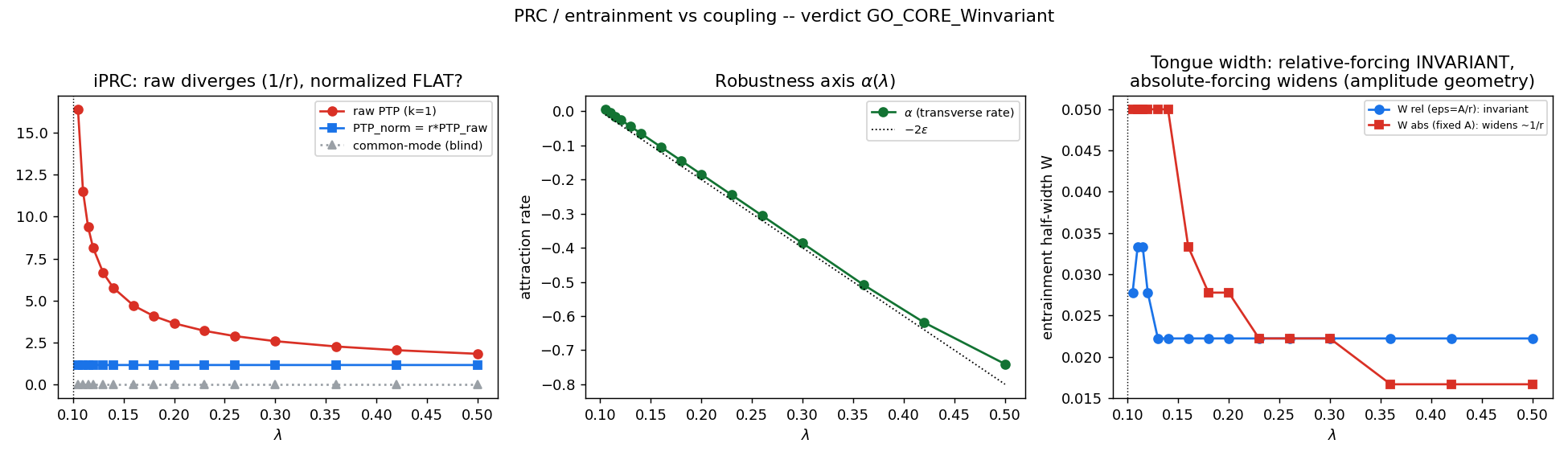
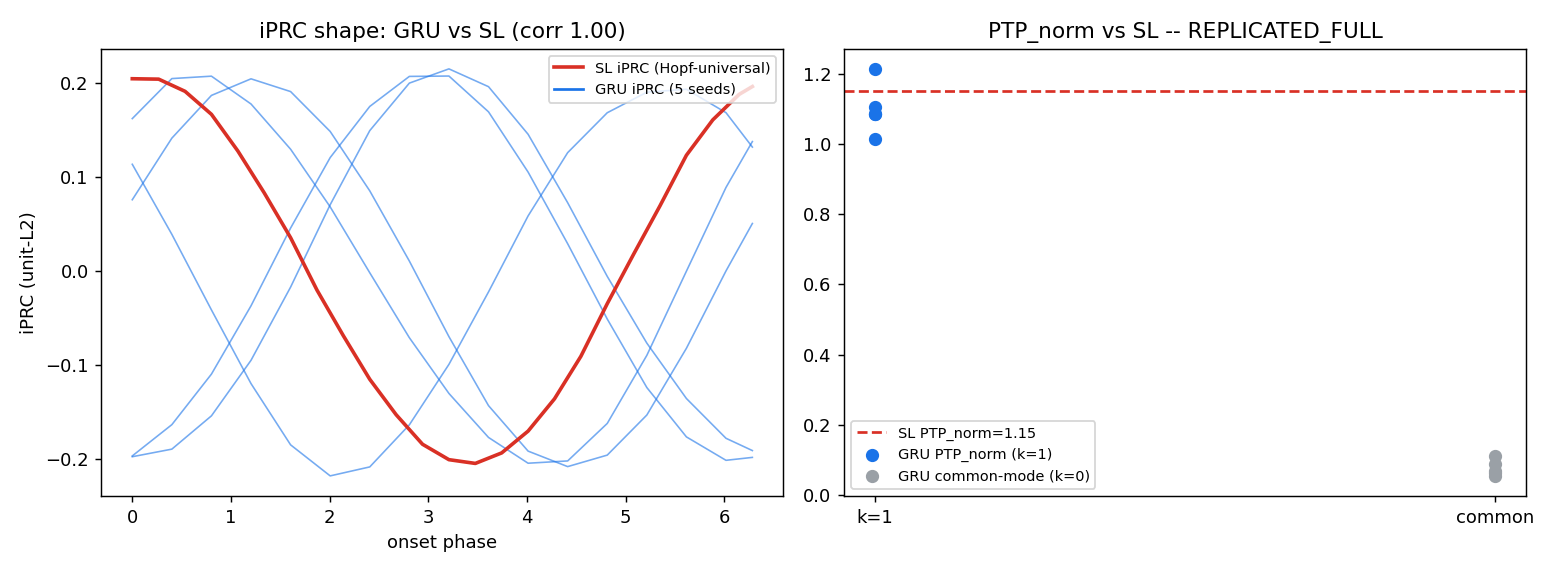
Pivoting from what it does not do (memory) to what it does (phase regulation) produced the program’s cleanest positive result — and a cross-substrate confirmation that it is not an artifact of the idealized model.
4 · The clean code is a symmetric idealization — but the real object actively holds it
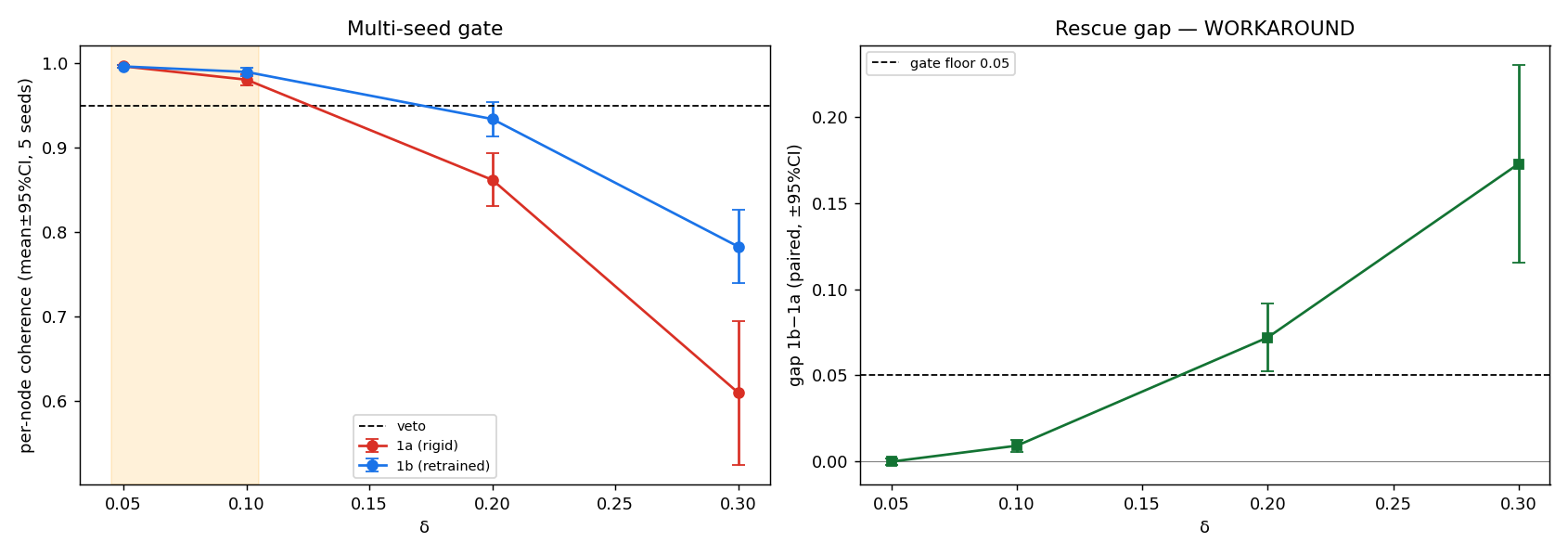
Everything above was proven in the symmetric triad. Breaking the symmetry (detuning the nodes) is the make-or-break test — and it separates the idealized model from the real one.
5 · The deepest law — existence is cheap; rotation is irreducibly active
A “zoo” of dissection experiments asked what it actually takes to make the oscillation self-sustain without the prescriptive loss. One law held across all of them.
A second emergent structure from the same zoo: when the triad’s weights are allowed to change during operation, a clean two-layer stratification appears on its own — a fast oscillatory state and a slow latent weight-memory, decoupled, with the attractor robustly screening the slow store from the fast state (constant gap across freeze configurations, five seeds). A fast-perceptual / slow-infrastructural split that is robust and not bypassable by structure — a candidate primitive for a perceptual module.
6 · And the founding intuition, tested head-on
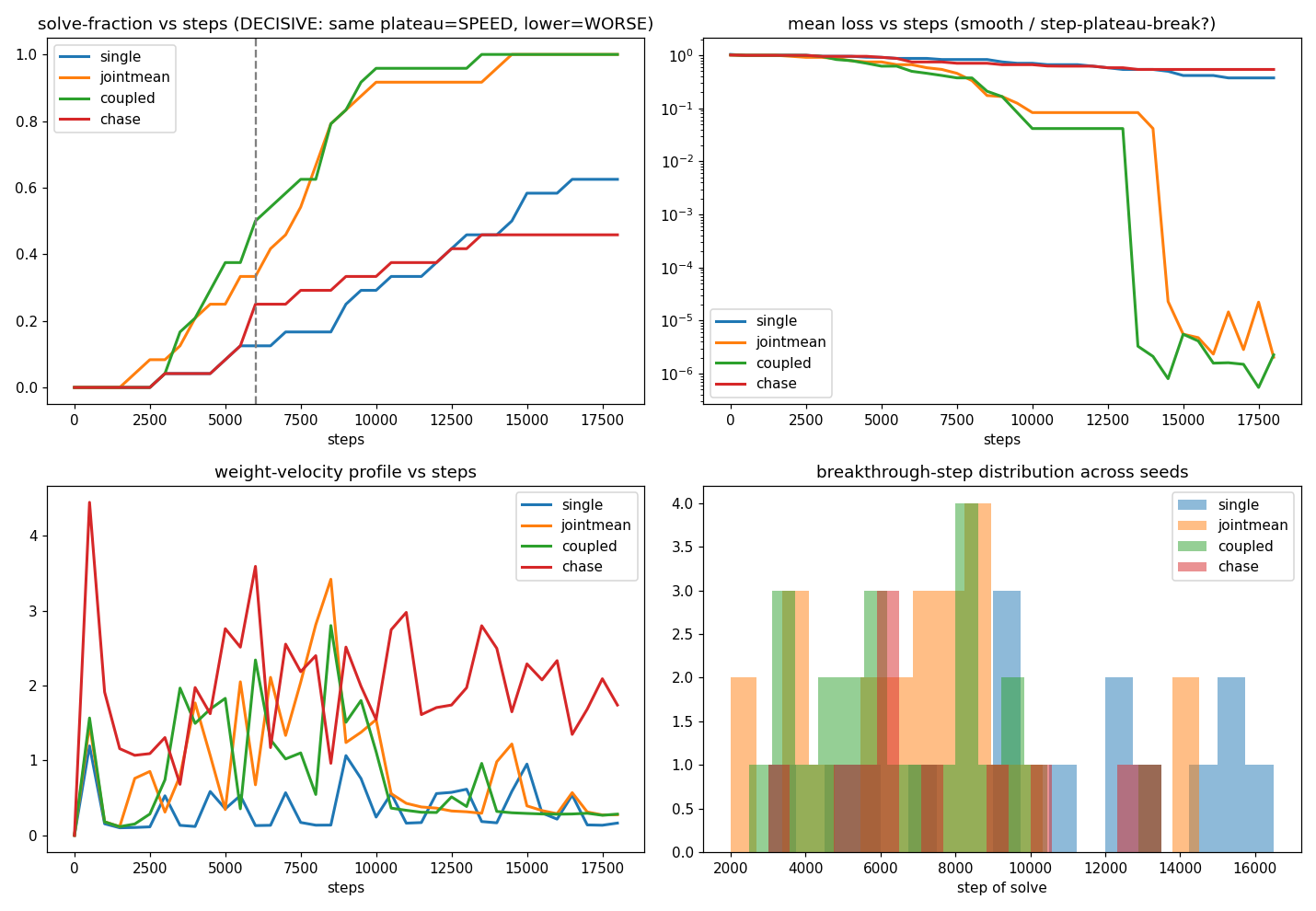
Do three coupled, non-settling nets solve a hard deceptive task better than one?
What was found
- The motor is real and trainable. SL Hopf at λ* = 0.10 (supercritical, r² = 1.000); a GRU triad self-organizes and self-sustains the 120° splay (5/5 seeds, 20/20 held-out ICs), coupling-maintained (re-locks after perturbation; dies in isolation).
- (Negative.) It is not a memory store — it stores less than a static line-attractor of equal capacity; coupledness and plasticity are antagonists. The founding hypothesis is refuted.
- It is a phase regulator with a Hopf-universal temporal code. The normalized iPRC is λ-invariant (CV ~3×10⁻⁵); coupling tunes only robustness (measured α ≈ −1.94ε, −2ε idealized). This universality is emergent in the trained GRU (shape-match 0.999), not a normal-form artifact.
- The clean code is a symmetric idealization that breaks under detuning — but on the real trainable object the breakage is largely a rigidity artifact, and re-training actively holds the coupled structure (multi-seed rescue gap, genuine non-bypass adjustment).
- The deepest invariant: an oscillation’s existence is cheap; its directed rotation — broken time-reversal symmetry — is the one irreducibly-active ingredient. On a dissipative map, smooth oscillation requires a complex eigen-pair.
- An emergent fast/slow stratification — the attractor screens a slow weight-memory from the fast state — a candidate perceptual-module primitive.
- The non-settling coupled dynamics buy robustness and structure, not the memory or optimization advantage hoped for — the prediction-chase is genuinely harmful; the committee gain is ordinary joint-training.
| Phase | Question | Verdict |
|---|---|---|
| Motor (SL + GRU) | Does the regime exist and is it trainable? | GO |
| Memory | Stores more than a static net? | REFUTED |
| Phase regulation | Hopf-universal code, coupling = robustness knob? | GO (emergent in GRU) |
| Asymmetry (SL) | Does the clean code survive detuning? | NO-GO (averaging artifact) |
| Asymmetry (real object) | Does the trained net hold it? | YES — actively adapts |
| Existence vs rotation | What is irreducibly active? | rotation (time-reversal breaking) |
| Coupled-nets-vs-1 | Does non-settling beat a single net? | no — chase hurts |
What this means
The founding intuition — that a perpetually-circling, non-settling system perceives or remembers more than a static one — is wrong in its strong form, and the program shows precisely why: the coupling that sustains the cycle suppresses memory, and the non-settling dynamics buy no optimization advantage over ordinary cooperative training. But the dissection that refuted it surfaced something cleaner. The collective oscillator is a genuine, trainable, self-healing phase regulator carrying a substrate-independent (Hopf-universal) temporal code, and the single ingredient that makes any of it active rather than decorative is directed rotation — the breaking of time-reversal symmetry. Existence is cheap; chirality is the cost. That is a sharper and more portable claim than the one we set out to prove.
Reproducibility
Every phase freezes its decisive metric and pass/fail rule before seeing data; decisive metrics are validated against synthetic ground-truth harnesses with negative controls before they touch real data (this repeatedly caught masking artifacts and false-GOs in the program’s own frozen decisions); results are multi-seed with confidence intervals. Two substrates throughout — an analyzable Stuart–Landau triad and a trained GRU triad. Code (plain PyTorch + NumPy), pre-registrations, result JSONs, and figures are in the repository: github.com/mool32/oscillatory-perception.
Part of the perceptome program · pre-registration discipline per the AI-collaborative research methodology. Theodor Spiro · ORCID 0009-0004-5382-9346 · tspiro@vaika.org