Theodor Spiro
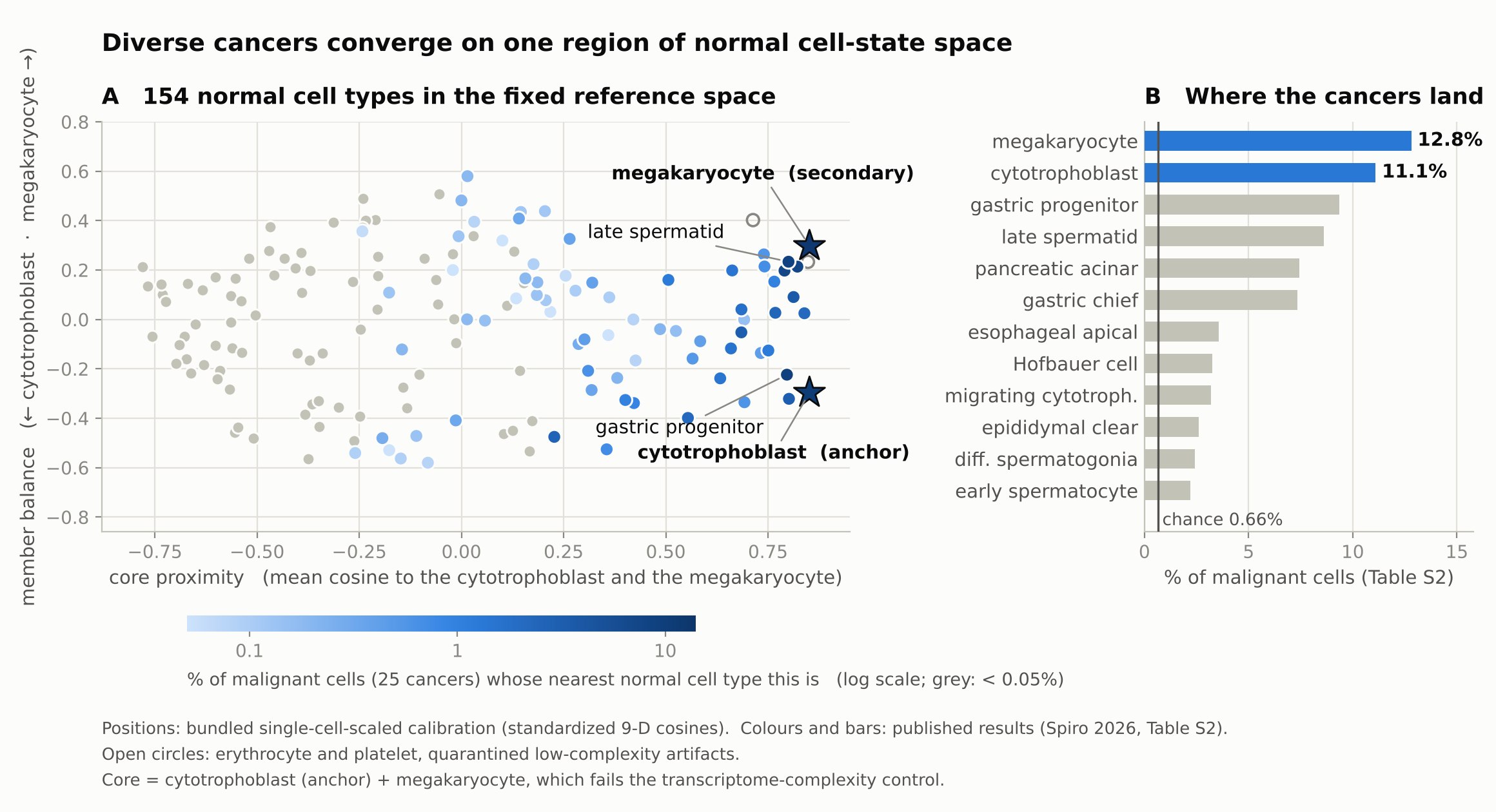
I build coordinate systems for cellular state, then test what they predict — predictions locked before the data, failures published next to the wins. The current result: malignant cells from 25 cancer types, across diverse lineages, converge on one restricted region of a map built from normal cells only — and within a patient, malignant epithelium occupies that state far more often than the patient's own normal tissue (colorectal: 43 of 46 patients).
Two directions
1 · Cellular perception — what a cell can sense, and where cancer takes it. perceptome treats 44 signaling pathways as a cell’s regulatory repertoire and places any cell on one 9-dimensional map (Python toolkit, Zenodo DOI). The cancer-convergence result above is what that map was built to test, and the preprint records what it retracts as carefully as what it finds. A related strand asks whether the same architecture holds in neurons: proteostasis modules causally enable memory consolidation — shown by a knockout that removes one arm of the machinery and the memory with it.
2 · Aging biomarkers, replicated across substrates. The same question — what degrades measurably with age — asked on three unrelated signals, each with cross-population replication as the default bar: the twelve-lead ECG (412,730 recordings, three continents), EEG waveform shape (823 adults, two cohorts, 5-year follow-up), and the transcriptome (GTEx plus three species).
Everything else — the comparative biology of neural networks, cognition instruments, cross-substrate methods — lives on Projects →.
Every claim here is checkable
That is the point of the setup, not a footnote:
- Predictions are locked before the analysis. Hypotheses, metrics and pass/fail thresholds go into a hash-stamped pre-registration first; verdicts cite the locked file.
- The failures are published too. A refuted founding hypothesis in oscillatory perception, a pre-registered negative where the method loses to a linear baseline, and an EEG non-replication across five datasets — all written up in full rather than dropped.
- Every result carries its code and a DOI. Nothing here rests on a claim you cannot re-run.
- This site is itself validated. Publications are generated from a single BibTeX source and checked in CI, so the record cannot quietly drift out of sync.
Selected work
-
Diverse cancers converge on one region of normal cell-state space in a cancer-blind coordinate systemA coordinate system for cellular state built from 44 regulatory modules scored across 154 normal human cell types -- no cancer data anywhere in its construction. Malignant cells from 25 cancer datasets land in one restricted region of it. Most of that contraction is shared transcriptional output; a smaller convergence in module pattern survives the matched null. The most defensible claim is within patients: malignant epithelium occupies the state far more often than the same patient's normal epithelium (colorectal 19 percent vs 3 percent, 43 of 46 patients), in every tissue tested except prostate. The nearest normal cell is the placental cytotrophoblast, but independent rebuilds of the catalog reproduce the region while naming a different cell -- the region is the robust finding, the anchor is conditional on this catalog.
-
Spectral exponents of the twelve-lead ECG reveal the anatomy of cardiac conduction disorders and a bifurcation between aging and diseaseSpectral exponent β extracted from 412,730 twelve-lead recordings across three continents (PTB-XL, Chapman-Shaoxing, CODE-15%). β is diagnostic of cardiac conduction anatomy: CLBBB vs CRBBB AUC = 0.982 (Germany), 0.982 (China), 0.979 (Brazil). Aging flattens the spectrum; disease steepens it. Honest null on independent mortality prediction (HR = 1.02, p = 0.83).
-
Transcriptomic noise accumulates within tissue identity across human aging: a systemic signature distinct from cell-composition driftThree-level variance decomposition on bulk transcriptomes from 263 GTEx v8 donors plus single-cell data from Tabula Muris Senis, Calico rat caloric-restriction atlas, and a rhesus macaque cross-species atlas. Tissue identity is preserved across forty years of aging; the signature is systemic noise, not selective accumulation. Caloric restriction acts as a noise filter, not a structure restorer. Cross-species lifespan scaling (α = −1.02, R² = 0.90).
News
- Jul 2026 Diverse cancers converge on one region of normal cell-state space — archived on Zenodo. A coordinate map built from 44 regulatory modules over 154 normal cell types, with no cancer data in its construction; malignant cells from 25 cancer datasets land in one restricted region of it. The most defensible claim is within patients: malignant epithelium occupies the state far more often than the same patient’s normal epithelium (colorectal 19% vs 3%, 43 of 46 patients), in every tissue tested except prostate.
- Jul 2026 Proteostasis modules causally enable memory consolidation — a pre-registered, cross-dataset dissection resolving memory consolidation into a three-layer cellular architecture (perception → sentinel → construction). TLR9 knockout selectively removes the ER-chaperone arm and impairs memory (direct causal evidence); 28/32 published perturbations predicted with zero contradictions. Sole-author manuscript, submission-ready.
- Jul 2026 metric-autopsy v0.1.1 released — a metric-agnostic gate system that red-teams a computed single-cell metric before you believe it. Eight gates catch dropout, library-size, batch and factorial-QC confounds; the reference metric in the worked example dies 0/N while a library-normalized one passes, so the confound is avoidable, not universal. Built from three of my own failures. Ships as a pip package, a Claude Code skill and an MCP server; 35 tests. Zenodo 10.5281/zenodo.21195679.
- Jun 2026 Oscillation as a constitutive substrate for perception — a multi-phase pre-registered dissection on a Stuart–Landau triad and a trained GRU triad. A trainable triad self-organizes a coupling-maintained 120° rotating limit cycle and self-sustains it with the loss off, but it is NOT a memory store (the coupling that holds the cycle suppresses capacity — the founding hypothesis refuted). It IS a phase regulator with a Hopf-universal temporal code, emergent in the trained GRU. The earned law: an oscillation’s existence is cheap; its directed rotation — the breaking of time-reversal symmetry — is the one irreducibly-active ingredient.
- Jun 2026 Neural-network fitting as a structure sensor — a pre-registered negative. An autoencoder’s unsupervised fit does not beat matched linear PCA at recovering donor age from immune scRNA-seq (GSE233321, 167 donors), and training erodes the signal; a synthetic positive control pins the exact regime where the method would win. The latent independently re-derives the perceptome eigenspace (CCA p = 0.001) but not its aging axis.
About
I’m an independent computational researcher based in Tel Aviv. My background is in biophysics (Lomonosov Moscow State University, Faculty of Physics), where my early work was computational modeling of cellular signaling — the thread that runs directly into the cellular-perception work anchoring the portfolio today. I am a 2026 Emergent Ventures grant recipient.
The independent research program runs from 2020. Since 2024 I have been affiliated with Vaika Inc., a not-for-profit aging-research organization, where my aging manuscripts are developed and reviewed.
I publish under one canonical name everywhere: Theodor Spiro (ORCID 0009-0004-5382-9346). Manuscripts and code are released at github.com/mool32 and on Zenodo / arXiv.